There was a time when television sets were switched off when Sachin got out. In those days, i used to sit with such attentiveness, as you would normally expect from a kid in a classroom but in my case it was in front of a television, because any ball could have been end of the match but in reality more often it was met with a with a stroke so delightful that my heart used to say "kya baat hai!"
The Image lingers on. Follow through of the bat after a cover drive - a small sized Tendulkar standing absolutely erect with the bat pointing in the direction of the ball, ball which has raced towards boundary piercing a 5 member vanguard meant exactly to stop that. With every year as i grew, i remember less and less about my adulthood but i am confident that these would remain with me. Fast paced bouncers outside offstump were one of the most difficult deliveries to play to until Tendulkar showed that you can simply glide them over the slip cauldron and suddenly they were freebie sixes. A leg spin delivery, pitched outside leg stump spinning into the right hand batsman was considered to be lethal on a spinning track until the little master invented "paddle sweep". Yes, a six gives more runs that a four but what about the joy coefficient? The straight drive by Tendulkar, irrespective of whether he was in form or not, gave so much pleasure that i will trade it anytime over his sixes.
One of my fond memory comes from Australlia's tour of India. During a test match, Glen McGrath runs up to bowl to Sachin and just before the ball is released Sachin raises his hand and says No. Glen is furious and as he asks what's going on, he comes to know that Tendulkar was not happy as people were walking close to the side screen. This will now continue to happen atleast 3-4 more times when McGrath, now even more furious than before, walks up to him and using hand gestures tell him - Why don't you ask the entire stadium to sit calmly? Sachin just shrugs and ignores him. Mcgrath smiles and goes back to bowl.
Critics criticize while doers do. Around 2001-2002, Sachin Tendulkar was labelled as only a first innings man. "He can't handle the pressure of a chase" slammed the critics. To a degree they were right, his first innings average was above 50 while his second innings average was just shy of 30. But data does not speak for circumstances. If wickets at the other end are chipping off, which happened most of the times in mid 90s, Sachin was forced to carry one billion expectations alone and his improvisations didn't work as much as he would have liked. The one inning that put all such accusations to rest was his 98 against Pakistan at the 2003 World cup quarterfinal match. Pakistan has scored 273 which was a fighting total on that pitch and Pakistan's bowling attack was at its prime during that time. This is also perhaps my favorite innings from the little master. On that day, Tendulkar came up with a new strategy to counter the attack. At the last moment before facing a delivery, he would shuffle at his crease towards off stump just a little bit. Now suddenly the corridor of uncertainty, the patch just outside offstump where a batsman is confused on whether he should play the ball or not, became straight for him. Any ball directed towards middle stump was almost on his pads and was played cozily on the leg side. India had scored about 100 runs in first 12 overs and Pakistan were out of their wits on what is going on.
Sachin was always a favorite, India adored him and rest of the world respected him. But the conversion from this to a God-like adulation, from opposition's respect to fear, happened at the Coca Cola cup at Sharjah in 1998 when he stroked back to back centuries and single handedly won the series for India. The assault was brutal and that too against the best ODI side at that time. Evidently, not many people write about it now, even though Sachin scored a century (actually 143 out of India's 250) India lost the qualifying match against Australia but had managed to qualify for finals. After the match, Sachin was actually upset at himself for loosing it. Such was his expectation from himself. For many of us, this has been a regular show - a lone Sachin trying to battle alone. During the 1999 test match between India and Pakistan, the first test match between the two rivals after nine years, India lost to Pakistan by 12 runs. India had scored 258 out of which 136 came from Sachin and 36 from extras. At the post-match press conference, media asked whereabouts of Sachin to Mr. Raj Singh Dungarpur, then BCCI president, to which he replied that Sachin is crying in the dressing room. And so was I in front of my tv set. My tears were partially there for the lost match but mostly i was sorry for Sachin who had given everything that day.
We were happy for him when India won the 2011 world cup. It was only fitting for the Indian team to dedicate the cup to him. It felt justified as if all the wrongs for all those past years had been corrected with this victory. But personally deep down, i always held the regret that we should have won the 2003 world cup. That Indian playing XI inspired true cricket for a fan like me. Plus, we reached the finals in an overseas pitch, something that is very difficult to achieve.
But after world cup came the disappointment period. If truth be declared, i wanted Sachin to retire then from both forms of cricket. There was nothing else for him to prove anymore. The 100th century media pressure appeared superficial to us. For people like us, 10K runs or 100th century never matters, these are by-products, the filings that you get as a stone is carved into sculpture. What matters to us is the class and the grace of those scored runs.
There was disappointment as it took him such a long time to achieve his 100th hundred but what followed after that was even more frustrating. Sachin, who had been so private in his victories, was paraded like a Miss Universe winner. The Ambani party proved such a big farce. It was like a marriage ceremony where unknown friends and relatives dance while you are just standing and watching them from a distance, unable to share any merriment. We felt betrayed. The media circus that followed was trying very hard to make it into a climax of a masala bollywood movie.And us, the indie art house lovers, could not do anything about it.
Deep down, we knew that it is time for him to step down. But who would bell the cat? Everybody hesitated and punted it back on to him - "Only Sachin can decide when he should retire". Harsha Bhogle thought different and articulated intelligently through this article.
As i heard news of his retirement, the inevitable had happened, a feeling of satisfaction took over soon followed by a sweet nostalgia. 10 years ago, me and my friends would often discuss this - what would Sachin's stats look like when he retires? I do not recall what our estimates were but a world cup win did feature in it.
Looking back, if Dravid is remembered as the Wall - thou shall not fall, Sachin would be remembered as a lone Samurai who never gave up hope even if circumstances around him were not optimistic. The man who stood his ground based on the strength of his convictions on his ability, the man who forced everybody else to see things his way, the man who gave a sense of belief to an entire nation. I learnt the meaning of "When the going gets tough, the tough gets going" from him. In future, experts will sing glories of his statistics, teach his shot inventions to youngsters and talk about his long career but they will still be holding back his true impact on this sport, on this nation. Our lives have been shaped by this genius, we the nation owe a big debt of gratitude to him.
Tuesday, December 25, 2012


Sunday, December 16, 2012
Life in Oct 22 - Dec 16
Too much of awesomeness - That's how i would like to describe this period. It seems like that week after week, there is something awesome happening around me. Here are the highlights -
~ Listening poems read by Gulzaar Saab at Bangalore Literature Festival. The first session was called Have you seen the soul? The craft of writing poetry. It was a conversation between Pavan K Varma and Gulzaar saab. The latter read his poems and former read its translations and the duo shared anecdotes of working together and how difficult it is to translate. The next session was titled - Subah Subah ik khwaab ki dastak par. While the first session focused on the craft, the second one was focused on the imagery in his poems. Dil khush ho jaata hai Gulzaar saab ko sun kar ke.
~ Ruhaniyat - a Sufi Mystic Music festival. Detailed report at - http://arvindbatra.blogspot.in/2012/12/ruhaniyat-2012.html
~ Between the lines - A play by Nandita Das. A little bit cliched writing but nevertheless a good topic and fine performance. Between the lines takes the issue of role of women in a marriage and analyzes it under the context of an actual legal battle where husband is the prosecutor, wife is the defendant in a case wherein the wife is accused of accidentally shooting her husband.
~ US trip - Bentonville, Grand Canyon, Alamere falls, SF Moma and office work.
~Movies - Lots of them.
Lincoln(4/5), The Master(3/5), The Sessions.(3/5)
Where do we go now, Polisse, Beasts of the southern wild, To Rome with Love, Brave, The odd life of Timothy Green
Chaalis Churasi(1/5), Hannah's Law (2/5), The Best Exotic Marigold Hotel (3.5/5), Halt (3.5/5)
Student of the Year (0/5) - Had to watch it as i had 6 hrs to kill in Chennai after my visa interview.
Dr. No (2/5).
~ The West Wing. Loved it! Watched seasons 1 to 4 in 3 weeks. Great political drama with very crisp writing, a clever screenplay and touching a side of politics that should be analyzed. Highly recommended.
~ Forrest Gump by Winston Groom. Listened to the Audio book. Taking this material and making a movie like Forrest Gump is a great feat. Liked the book in parts, not so in other but it fails completely in front of the movie
~ Finished Greek and Roman Mythology course on coursera. Passed with distinction.
~ Read Listening to Grasshoppers: Field notes on democracy by Arundhati Roy.
~ Go Karting with office colleagues.
~ A day trip to Chennai for visa interview.
Ruhaniyat 2012
Upon entering a makeshift gate into the empty ground in front of the Jayamahal Palace hotel, a wind of peace greets you leaving a sweet smile on your face. An Egyptian saintly artist is playing a Santoor like instrument on a mildly lighted stage under a tree which is reflecting rainbow colors from its branches. Such is the welcome imagery at the 12th edition of Ruhaniyat 2012 organized by the Banyan tree group.
The way of the spirit or Ruhaniyat, an annual Sufi Mystic Music festival, brings diverse Sufi artists under one theme - that of touching your soul. The Bangalore edition started with Zikr-e-Rigayi Fakirs from Andhra Pradesh, a 11 men troupe, singing devotional prayers. This was followed by Vaya quartet from Bulgaria. Trained from as early as five years of age, Vaya quartet uses vocal harmonics to sing traditional folk Bulgarian songs. Their voice has an angelic beauty and softness that transcends the language and its meaning, just close your eyes and you can feel the playfulness, the love and pure mood of celebration.
 |
| From Bangalore Events 2012 |
 |
| From Bangalore Events 2012 |
The next performance was by Kachra Khan and group performing various Sufi Kalam and mystic songs. One member of the group, sitting at far left with his kit-kit like instrument and an infectious energy just made our hearts dance inside us. This was followed by an impromptu Jugalbandi on stage between the group and two instrumentalists from Egypt. A mix of soulful instruments, sharp percussion beats, a slow cool breeze and artists who are just enjoying themselves , a recipe of unbound pleasure.
 |
| From Bangalore Events 2012 |
Parvathy Baul came next and i do not know how to describe her. She plays small table with her left hand, an ektara with her right hand, sings mostly at a high pitch and then dances with ghongroos on her legs - all at the same time. Parvathy has been associated with the festival since its first year and her solo performance transports one back to the age of Megha Dhake tara where the lone Baul singer is singing "Maaji tumhaar naam jaani na". How much i wish she would sing that line.
 |
| From Bangalore Events 2012 |
Just when you believe that you have seen the most extraordinary performance of the night comes the Egyptian duo of Dancing Dervishes performing the Tannoura. The following video is an example performance -
The evening was brilliantly anchored by Banyan Tree, every performance was preceded by the anchor explaining the theme or mood behind every rendition. At the end of the Tannoura performance, as an FYI, the anchor mentions that each skirt weighs about 20 kgs in weight in case you thought that it was light to carry and whirl. Tannoura is an extension of Sufi whirling - a physically active meditation in which the dervish aims to reach the source of all perfection.
 |
| From Bangalore Events 2012 |
The final performance was an hr long plus Sufi Qawalli by Fareed Ayaz and group. Starting with the ever lively Allah Hoo, they sang Kabir vani, Baba Bulle Shah finally ending with Amir Khusro's Aaj Rang hai. Qawalli as a performance is so rich, nuanced and meaningful, it is hard to fathom that the only instruments in play are harmonium, tabla and hand clapping. It has so much power that even a non-believer will start believing just to share the experience of praying like a Qawwal.
At the beginning of concert, i had wondered - what would be the way of a spirit? (Ruhaniyat kise kehte hain). At the end, i knew the answer. It was in Parvathy Baul, it was in the spins of Devrishes, it was in the voice of Vaya quartet, and it is in the voice of a Qawwal. There are many Ruhaniyats, inshallah, shayad humein bhi naseeb hogi!
Saturday, December 8, 2012
Bentonville
It was a work visit that took me to Bentonville, Arkansas. Prior to my visit, people had told horror stories about the place. Stories included dearth of vegetarian food, warehouse converted into offices and there is no life in the town. Five minutes after landing, i knew that i am going to like the place. You ask why? Because of all the open space around us. I could see fields, cows, and houses with fences that covered land as big as football fields.
Most of the time at BV was spent in meetings and yes, those meeting did happen in offices which had no windows (they could have been warehouses as well). But everything else was quite good.
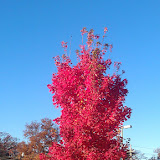
The first thing that stood out at BV was the fall leaves on trees. Those gorgeous reddish-orange-yellow shining leaves act as though they inhale tension and exhale freshness. It was a delight to see them everywhere and how can a place be depressing when its trees have such kind of leaves.
On a casual stroll one morning, just few meters away from my hotel, i came across some of these homes which looked like the image below. It was quiet, no traffic, lots of empty spaces and such a relaxed place to live in. There in front of me was the countryside, the scenery of The Straight Story which i had admired and desired so much.
On the last day, we briefly visited Crystal Bridges - the contemporary art museum there. Like a gateway to a different world, it hides the Ozark forest in its backyard and inside hides art pieces chosen diligently and houses one of the most brilliant art works of our time. There are even some 3 miles of hike trails around it but we didn't do anything but just to make a note of things to do the next time.
Bentonville may not be a very happening town, there may not be many pubs or hangout places or there may not be much diversity in employment opportunities. But it offers something that, i guess, only those who have grown up in small towns can comprehend. It offers free space, nature, a DIY experience that is missing and finally a slow pace of life that we all yearn for.
 |
| From BentonvilleTrip |
 |
| From BentonvilleTrip |
Bentonville may not be a very happening town, there may not be many pubs or hangout places or there may not be much diversity in employment opportunities. But it offers something that, i guess, only those who have grown up in small towns can comprehend. It offers free space, nature, a DIY experience that is missing and finally a slow pace of life that we all yearn for.
 |
| BentonvilleTrip |
Grand Canyon
Two friends met after a year and were sipping coffee. One wanted to get away from all the daily humdrum and other wanted to know what he can do with all the free time he had. Both unaware of each other's reasons. One said - "I am planning to visit Grand Canyon, chalna hai?" And prompt came the reply - "chalo" . And so Manas and me went to Grand Canyon. A big thanks to Manas for his company!
With a round trip ticket from SFO-LV costing only $65, we booked Spirit airlines. Spirit had a rating of 1 out of 5 only because people could not rate zero. But in terms of ROI it will be ranked one of the highest. I had no complaints whatsoever.
People land in Las Vegas, then drive from LV to Grand Canyon and finally hike to bottom of the rim all in one day. By the time we reached Grand Canyon, Sun was already down and even the visitor center was closed. Our drive was full of halts and we spent good amount of time at Hoover Dam and Pat Tillman bridge, longer than we should have. Our lunch stop was at an all American Diner called Griddles which had a hard time finding vegetarian place for us. But in the middle of nowhere, Griddles is a specialty restaurant, here there are no plates but instead small griddles made up of some aluminum compound, or may be it is a toast to some bygone era.
It was before dawn when we left our lodge. We started hiking the Rim trail on the Western edge when it was twilight and hiked all through Dawn untill we were at Powell's point to see the Sunrise. Sunrise was beautiful.
Grand Canyon is beautiful if you just look at it. It goes forever in either directions and as you look at it, you feel that you are witnessing something extraordinary. For many, this may be it. But the true trance feeling comes when you just sit there and look it calmly. It is a therapeutic experience. One can't get enough of it. As you focus your attention to one part of the canyon, there is another part howling for you attention. The rocks in front of you have been there since the day Earth was born, they have seen everything. On the lighter side, my thought went to the Total Perspective Vortex in The HitchHiker's guide to the Galaxy, the ultimate torture device, which showed you how tiny you are in the entire universe. Similarly, grand canyon reminded me how small is our life span compared to this canyon, but instead of being tortuous, it was a serene feeling. If there needs to be a teacher to teach you that your life span is indeed small given the entire universe, the teacher has to be similar in size and magnitude of the Grand Canyon. Global warming, pollution, sea level rise etc etc, as if the Grand Canyon is trying to tell us - i have seen everything before and have survived and so i will do now, you worry about yourself. The beauty of Grand Canyon comes from its scars and ridges, it is the face of a strong man who has bore everything. Like the Atlas who carried the world on his shoulders, the Atlas who is refusing to shrug.
As you sit there and see the Sun rise up and down, you quickly realize that every second imagery at Grand Canyon is different. The interplay of shadows from one canyon to another is very fascinating, one could never get tired of it. We saw the Grand Canyon from the Hermit's rest, from the East side and then later from the Desert Watch Tower. Next day, we saw it from Yavapai point and another point whose name i have forgotten now.
We hiked the trail going down for about 1.5 miles. We were extremely negative about our ability to hike, so much so that what we had estimated would take 4 hrs, we were done in 2.5 hrs. The biggest disappointment from the trip would be our inability to hike down to the base. We should have planned better and we should have done it. But even in that 1.5 mile hike going down, the view changes every half mile and it offers a unique perspective. We also joined the elite group of 5% of visitors who visit every year and take a step below the Rim. For the most part, people are happy to stay at the Rim itself.
On the last day, we took a Ranger tour where a Ranger explained to us how nature works symbiotically at the Canyon. The Ranger's enthusiasm to explain things was infectious. It was an informative tour. What should have ideally been our first stop became our last and so we went into the visitor center. This photo of the first group of people who came to Grand Canyon by the Colorado river is something that i still reflect upon sometimes -
Other GC excursions included watching a documentary on Grand Canyon, visiting the Train depot, a failed attempt to see Sunrise on the next day, another failed attempt to listen a talk on importance of Fire as i slept midway, and a visit to the Tusayan museum. Also, we stopped at Route 66 both while coming and going as it was just interesting to witness a town that would have been at its prime decades ago but now is struggling to attract tourists. Imagine if that will happen to Manhattan and Times Square. The imagery of a deserted Time Square signals doom of mankind in my mind.
The complete album can be seen at -
With a round trip ticket from SFO-LV costing only $65, we booked Spirit airlines. Spirit had a rating of 1 out of 5 only because people could not rate zero. But in terms of ROI it will be ranked one of the highest. I had no complaints whatsoever.
People land in Las Vegas, then drive from LV to Grand Canyon and finally hike to bottom of the rim all in one day. By the time we reached Grand Canyon, Sun was already down and even the visitor center was closed. Our drive was full of halts and we spent good amount of time at Hoover Dam and Pat Tillman bridge, longer than we should have. Our lunch stop was at an all American Diner called Griddles which had a hard time finding vegetarian place for us. But in the middle of nowhere, Griddles is a specialty restaurant, here there are no plates but instead small griddles made up of some aluminum compound, or may be it is a toast to some bygone era.
It was before dawn when we left our lodge. We started hiking the Rim trail on the Western edge when it was twilight and hiked all through Dawn untill we were at Powell's point to see the Sunrise. Sunrise was beautiful.
Grand Canyon is beautiful if you just look at it. It goes forever in either directions and as you look at it, you feel that you are witnessing something extraordinary. For many, this may be it. But the true trance feeling comes when you just sit there and look it calmly. It is a therapeutic experience. One can't get enough of it. As you focus your attention to one part of the canyon, there is another part howling for you attention. The rocks in front of you have been there since the day Earth was born, they have seen everything. On the lighter side, my thought went to the Total Perspective Vortex in The HitchHiker's guide to the Galaxy, the ultimate torture device, which showed you how tiny you are in the entire universe. Similarly, grand canyon reminded me how small is our life span compared to this canyon, but instead of being tortuous, it was a serene feeling. If there needs to be a teacher to teach you that your life span is indeed small given the entire universe, the teacher has to be similar in size and magnitude of the Grand Canyon. Global warming, pollution, sea level rise etc etc, as if the Grand Canyon is trying to tell us - i have seen everything before and have survived and so i will do now, you worry about yourself. The beauty of Grand Canyon comes from its scars and ridges, it is the face of a strong man who has bore everything. Like the Atlas who carried the world on his shoulders, the Atlas who is refusing to shrug.
 |
| From Grand Canyon |
As you sit there and see the Sun rise up and down, you quickly realize that every second imagery at Grand Canyon is different. The interplay of shadows from one canyon to another is very fascinating, one could never get tired of it. We saw the Grand Canyon from the Hermit's rest, from the East side and then later from the Desert Watch Tower. Next day, we saw it from Yavapai point and another point whose name i have forgotten now.
We hiked the trail going down for about 1.5 miles. We were extremely negative about our ability to hike, so much so that what we had estimated would take 4 hrs, we were done in 2.5 hrs. The biggest disappointment from the trip would be our inability to hike down to the base. We should have planned better and we should have done it. But even in that 1.5 mile hike going down, the view changes every half mile and it offers a unique perspective. We also joined the elite group of 5% of visitors who visit every year and take a step below the Rim. For the most part, people are happy to stay at the Rim itself.
 |
| From Grand Canyon |
On the last day, we took a Ranger tour where a Ranger explained to us how nature works symbiotically at the Canyon. The Ranger's enthusiasm to explain things was infectious. It was an informative tour. What should have ideally been our first stop became our last and so we went into the visitor center. This photo of the first group of people who came to Grand Canyon by the Colorado river is something that i still reflect upon sometimes -
 |
| From Grand Canyon |
Other GC excursions included watching a documentary on Grand Canyon, visiting the Train depot, a failed attempt to see Sunrise on the next day, another failed attempt to listen a talk on importance of Fire as i slept midway, and a visit to the Tusayan museum. Also, we stopped at Route 66 both while coming and going as it was just interesting to witness a town that would have been at its prime decades ago but now is struggling to attract tourists. Imagine if that will happen to Manhattan and Times Square. The imagery of a deserted Time Square signals doom of mankind in my mind.
The complete album can be seen at -
Saturday, December 1, 2012
On Reading Arundhati Roy
Once my family was visiting my cousin's place. My 6 year old nephew after saying the usual greetings went back to watch his TV in the living room. We also started chatting right next to him in the living room. After a few minutes, he asked his mother to give him some MnMs. His mother said in a minute and she was back in conversation with us. After a few seconds, he tried again but with no response this time. This request-response must have happened three times more when he stood up and yelled at the top of his voice "You are not listening to me". This is exactly the image that come to my mind when i read Arundhati Roy. Somebody who is yelling at the top of her voice because "we" are not listening.
In her Defense
Ms. Roy's critics claim that hers is the voice of extreme left. She is angry with anything and everything. She knows only to make noise and nothing else. I do not deny their argument. But imagine a situation when your house has been robbed and you go to a police station and nobody is listening to you, what will you do? You will be angry and you will shout. Such is the plea of Arundhati and in this writer's mind, she does an extremely good job by bringing that anger to her writing without loosing her temper.
Godhra , Naxalite movement or even Kashmir, there is a much sinister play here which has to be understood in the right context. It is not a denial of acknowledgement but rather a refusal to acknowledgement. Because "denial" would mean partial knowledge or inefficiency or carelessness while "refusal" is a blatant statement saying that it never happened. Arundhati Roy is fighting against this "refusal" mentality and she is also under a clock because public memory is short-lived.
In her article on Godhra, she spends considerable time on defining why Godhra was not a riot but a genocide. In the case of Afzal Guru where Supereme Court in its judgement wrote this - "The incident, which resulted in heavy casualties, had shaken the entire nation and the collective conscience of the society will only be satisfied if capital punishment is awarded to the offender." She rightly questions our democracy when the supreme body of judiciary is basing its decision on satisfying the collective conscience of the society.
The Tone
In the article - "How deep shall we dig?", Arundhati takes liberalization policies 1991 and places them next to the Rath Yatra by Advani and writes - "While one arm is busy selling off the nation's assets in chunks, the other, to divert attention, is arranging a baying, howling, deranged chorus of cultural nationalism". Her essays are filled with such acerbic comments, these simply can't be ignored. It is at the phrase "to divert attention" in the above quote where a reader, like me who agrees with most of her viewpoints, feels put-off and frankly short-changed.
Arundhati definitely has a flair for writing good prose (she even has a Booker prize in fiction to prize for this) but it feels like she often succumbs to her own internal demons and ends up applying her talent to take cheap shots. There is a fine line between satire and ridicule and she crosses it again and again. It is her sarcastic tone, the air of superiority that i am right and you are not, the "You-have-to-be-a-moron-to-not-see-this", which gets in the way of people taking her more seriously. It is also her tone which gets more attention than her content. We discussed her book - Listening to Grasshoppers - Field notes on democracy, as part of our book club and couple of people mentioned that after reading a few essays, their reaction was "Stop! Please stop". Mind you, it was not the heavy content that made them say this, it was the vinegar representation of fundamental issues.
With every writing, Arundhati has made more enemies than friends. Earlier this year, she wrote "Capitalism, A Ghost story" in which she criticized practically any company that has existed since the dawn of civilization. The article offers anecdotes bashing one company after another but it fails to make any attempts to highlight issues at a theoretic level. Neither it offers any solution to Capitalism, nor it argues for any alternate theory. At the end of reading that article, one is left with a lingering question - "What is the point of all this?
The Necessity
With all the arbitrary claims, metaphors and ridicule, the obvious question are - Does she bring anything to the table? or in other words Do we need Arundhati Roy? The answer is a big yes. We definitely need a voice that represents the left, even though it may the voice of extreme left, to counter the extreme right. There are still people in this world who like the idea of Modi as Prime Minister, who believe that the man is the force behind the (aura of) development in Gujarat and who do not believe (or are willing to overlook) his complicity in Godhra. We need talk to these people because every voice of reason and fairness has failed us. We need to shame them, to make them realize the fallacy in their arguments, to put them to the same standards as they have been putting for the rest of us. This is precisely why we need her, to do the balancing act. To yell because every attempt for a calm and productive conversation has been a waste of time.
One can go to a solution only after one acknowledges that there is a problem. Arundhati's battle is to ensure that we acknowledge that there is a fundamental problem. Readers who are aware and understand the problem, are not her audience. If you are looking for an all-fact coverage, she is not the right choice. If you are looking for solutions, she is not going to offer any. But at the same time, those readers should not shun her. We should lend support wherever we can because we are anyways loosing the battle. We should not fight among ourselves even though there exists considerable differences in our approaches taken. We should be thankful to her for bringing these issues up and voicing out a side that everybody else is so keen to suppress. We should realize that we also need her if at all there is hope for a better future.
Sunday, November 25, 2012
Introduction to Sustainability
In the last week of October, i finished my yet another coursera course - Introduction to Sustainability taught by Dr. Jonathan Tomkin of UPenn. I am quite glad that i took (and finished) this course, although i would have liked it even better if i was more rigorous at it.
Introduction to Sustainability adds a scientific basis to the the concept of sustainability. For example, we know that over-population is bad but can we define it quantitatively? What has been the historic impact of population on other indicators say, nutrition (food) or what are the projections of population growth of our planet. Primarily, this course helps you go one level down and adds more data/background to concepts that one agrees with (more or less) and helps you make informed arguments.
Here in this article, i would like to talk/refer to concepts/articles that i found to be informative.
1. The Tragedy of Commons - I may have heard of this phrase before but i never knew its meaning or origins before this article - http://www.garretthardinsociety.org/articles/art_tragedy_of_the_commons.html. Please read the article completely to understand the phenomenon. Having read and understood it, to take everything around us and give a foundational reading and to name it so aptly, it was almost like a intellectual "Eureka" moment.
2. Climate change and Global warming - Do you believe in Global Warming? Yes, i do. Many Republicans/Americans/even a few academicians do not believe in it, do you know why? Because they are morons. I never understood how come anybody will not believe in Global warming. This course clarifies this concept by explaining (a) many natural processes that participate in keeping our environment as it is. (b) How do we measure past / present data , (c) Why the skeptics do not believe in global warming and (d) Why they are wrong or in other words, why indeed there is global warming. A recommended link - http://climate.nasa.gov/keyIndicators/index.cfm#globalTemp
3. Geo-engineering - A process by which we can slow down global warming artificially. See this ted talk - http://blog.ted.com/2007/11/13/david_keith/. What followed was an interesting discussion on why we are even discussing techniques such as this when we do not know its unintended consequences.
4. From the energy lecture, i am sharing the TED talks which are very interesting -
http://www.ted.com/talks/hans_rosling_and_the_magic_washing_machine.html
http://www.ted.com/talks/rob_hopkins_transition_to_a_world_without_oil.html
http://www.ted.com/talks/stewart_brand_proclaims_4_environmental_heresies.html
5. Policy and how to evaluate - Pigovian Tax, Externalities - Positve and Negative, Willingness to Pay and Willingness to Accept, Property Rights, Command and Control Regulations, Incentive based Regulations, Cost benefit analysis, Precautionary Principle, Polluter pays
6. Economic Invisibility of Nature - http://www.ted.com/talks/pavan_sukhdev_what_s_the_price_of_nature.html
7. Shocking -
http://www.ted.com/talks/capt_charles_moore_on_the_seas_of_plastic.html
India's water crisis
9 billion-people question and No easy fix
At the end of the class, the general sentiment was that everyone agreed that we are in a very bad shape but there is small hope. A hope that comes from the fact that atleast we understand the problem, there is a wider acknowledgement about it and we will act on the knowledge that we have now. The greatest fear is that perhaps it may be too late by the time we come to our senses.
Saturday, November 24, 2012
Flight movies - BLR to SFO
There is sheer joy in watching movies on a long flight. Very akin to reading books on a train. After all, a faster mode of transport deserves a faster mode of media as well.
To me, the flight seat is nothing but a mini theater. You have got a semi-reclining chair, a small tv personally for you, headphones and a constant supply of drinks and food whenever wanted. Lastly, a collection of films to choose from. It is not only the setting that counts here but also the opportunity. In any season, there are very good movies that you watch out in theaters, but there are many good/decent movies which you couldn't watch because of time constraints or they were not deemed good enough to be watched in theaters. Flight time gives you that opportunity to catch up to these good movies, a time when these movies are not threatened by competition vying for my time. And ofcourse, there is always a scope to rewatch one or explore a totally random one.
So, without any further delay, here is the list from BLR to SFO.
Beasts of the Southern Wild - Let me start by saying that you have not seen anything like BOTSW before and it is unlikely you are going to see anything like it in future as well. Watching this movie is like watching a natural disaster in action - it is scary, emotionally draining, and gigantic but at the same time it is beautiful to watch - beauty that comes with shades of sadness, serenity and inner peace. The 6 year old protagonist, Hushpuppy, is a tour-de-force on herself; on one side we are enchanted by her energy and positive outlook but on the other end, we are shit-scared for here because after all she is just a six year old. She is the beast of the southern wild, a beast that has to fight to survive but at the same time knows that the wild has to be cherished as well. BOTSW is a triumph of making movies with imagination, it is a triumph of execution on a vision that the director wanted to share with others. Watch it if you love movies because this is a movie which values this medium for what it is and nothing else.
Where do we go now - Nadine Labaki's Where do we go now is a Leabanese movie on how women in a village try to resolve conflict between muslim and christian men. Their approaches are hilarious, weird and as one says it in the movie - "it might just work". WDWGN is a decent effort. It lacks in depth both in story and performance. It feels that the movie is unsure whether it wants itself to be a realistic portrayal of the religious tension or a comical take on a issue which should never have happened in the first place. However, the localization in the movie is indeed commendable and it transports us back into the era where TV watching was communal and community was the biggest entertainment there was.
Polisse - Polisse is a realistic portrayal of SVU-like unit in France. It is a docu-drama aka based on real stories but portrayed fictitiously. After merely three minutes into the movie, you realize that it is not going to be an easy one to sit through. Yet, Polisse must be watched, just to remind ourselves that there are real people doing this tough job, to understand that it is not easy to mix professional and personal lives for them. Polisse does feel cliched at times but it rarely feels far from reality. It has been compared to The Wire which is next on my watchlist.
The Odd life of Timothy Green - I had only one reason to watch this movie - Jennifer Garner. It felt like Garner's Juno like character again, so i decided to watch it. It is a cute little movie which always feels far-fetched, too fantastical and never moves you like other good movies in this genre. The storyline is bad, predictable and does not go anywhere. Garner's acting is the only thing that is good for the movie. It is a family movie to be watched with your children who have not entered their teen years.
To Rome With Love - I never wanted to watch TRWL because i knew i will be disappointed. I know Allen wants to make these short movies but there is no reason why they should be combined altogether. After midnight in Paris, which was so awesome in its plot and structure, TRWL feels like Allen made this movie just because he promised someone that he would do it. There are elements which give this movie a feeling that it is indeed an Allen movie but like his other recent attempts, it lacks a holistic feel. Allen may be paying homage to the city but the stories are so far out there that other than the location, there is nothing Rome-ish in it. TRWL in the end feels like an American's view of Rome than what it ought to be. The fact that it is an Allen movie just makes us, Allen fans, sad, very sad!
Brave - In the nascent years of animation medium, good animation and a decent plot was good enough for people to love it. But off late, with such amazing story lines coming into it, the genre has been redefined in particular for the mature audience. Brave has good animation but its story potential is only good for children. Few years ago, even adults would have enjoyed it because it was primarily the medium that was being cherished. But now, the expectations are higher. Brave is a good children's movie. For children, it has elements of fairy tales, comedy and be--good-do-good plot which goes well. But compared with its contemporaries, it has to do a lot better to appeal to me.
Wednesday, November 21, 2012
Fantasy and Science Fiction
OMG! Literally :) This should have been a October post. Not even October, it should have been in September. But November it is.
Fantasy and Science Fiction - A course on coursera taught by Prof. Eric Rabkin.
I like the way Eric describes the nature of fantastic - "...the diametric, diachronic reversal of the ground rules of the narrative world."
After reading Harry Potter series, LOTR and more recently GRRM, i knew that i loved fantasy genre. After all, i am a true escapist at heart. (And why not in this real world.... more on this later). But it was not any kind of fantasy that i like. Political drama like GRRM with good prose is always a favorite. I reread LOTR last December just to remember how good it was. I liked HP series never for its prose but how the jigsaw puzzle unfolded and connected everything in the end.
According to GRRM, people don't like fantasy because of magic spells or dragons. In LOTR, when there was war, Gandalf was not fighting with spells and curses, he had a sword in his hand. My thesis here is that (a) fantasy shakes the ground rules of our world and that is what makes it so appealing and (b) It is not the props that matter, it is the interaction between reality and those props.
(As a sidenote, herein lies why the battle scenes in Harry Potter movies do not work because there is no excitement in watching two people fighting with muted breaths and words with a broken stick on their hands).
As far as Science Fiction goes, the genre never appealed to me. I have never really enjoyed Star Wars. I read Ender's game last year and found it to be too young adult-ish (read childish). Battlestar Gallactica was impressive but again not due to its SF elements but because of its political drama. I believe that the whole SF genre is way more popular in US that India because of the cultural context that they grew in. But, it is not to say that i am not amazed by SF. I truly believe that the power of science as a fantasy tool has endless possibilities but just that before this course, i had not come across any good SF writing.
I also believe that mythology is an extension of fantasy. Having read, and thoroughly enjoyed, Mahabharatha and Illiad before, i didn't see them as religious texts but as one of the best writings of fantasy ever possible.
So, my motives for taking this course was to know more about great writings in this genre. The course description had Dracula and Frankenstein. I have never been a fan of horror genre either, so i thought it was a good way of getting into its roots as well. It was to be a demanding course - 10 novels in 10 weeks. The course outline is copied below -
Grimm — Children's and Household Tales
Carroll — Alice's Adventures in Wonderland and Through the Looking-Glass
Stoker — Dracula
Shelley — Frankenstein
Hawthorne & Poe — Stories and Poems
Wells — The Island of Dr. Moreau, The Invisible Man, "The Country of the Blind," "The Star"
Burroughs & Gilman — A Princess of Mars & Herland
Bradbury — The Martian Chronicles
LeGuin — The Left Hand of Darkness
Doctorow — Little Brother
Off the above, i didn't get time to read Poe. I couldn't finish Island of Dr. Moreau and i read the wrong Bradbury (idiotic mistake) - I read a graphic novel adaptation of The Martian Chronicles instead of the actual book.
The course is designed intelligently. Not only it goes from fairy tales to horror to SF to modern fantasy, the writings selected are also in chronological order. This shows how the genre has evolved over time. The books chosen are the ones that has helped in shaping the genre. I especially enjoyed the fact that i read Dracula and Frankenstein back to back.
Among the list, the ones that i disliked the most was Burrough's A Princess of Mars. I found it to be too YA and lacking completely in prose. Followed by Alice's Adventures in Wonderland which outside of the wordplay (which is excellent), i found it falling abysmally short in plot and story elements. My favorite were Stoker's Dracula (oh how much i enjoyed reading it) and Wells' stories. I liked how Wells deconstructs the grandeur perception of super-hero abilities. The one that surprised me the most was Gilman's Herland. I had never read a utopian novel and to read a feminist utopian novel was simply a treat. It was a very refreshing read and it was the one that broke most of the ground rules. Doctorow's Little Brother was the most "masala" book of the lot, it is an ideal summer beach reading. But as Eric explains in his lecture, it is not at all an easy task to write in this manner. The craft is much more appreciated after attending the lectures.
We had to write a small essay on every book offering an insight about the book which will be useful for others. It was a good creative exercise to do so. Reading peer responses was also quite informative. Coursera has done a good job in creating a platform to do so. The discussion forums were too noisy but some of the popular posts were a delight to read.
Forrest Gump
I do not remember what was my reaction after watching Forrest Gump for the first time. All i recall is that i liked it. Especially Tom Hanks. Forrest Gump was also one of my early movies when i realized how powerful this medium can be. Over the years, i have watched Forrest Gump multiple times. There are so many favorite scenes in the film, so many concepts that strike at heart. For example - The one when Forrest starts running just like that, or the one where Lt. Dan joins Forrest on his shrimp boat and the scene where he is challenging the storm. The one when he meets Jenny at Washington, and the one when he realizes that he has a son. The movie is layered with scene after scene that just makes it a treat to watch. But the one scene that stays with me even after the movie, long long time after the movie is this one -
Jenny is on her deathbed and is afraid of her dying. She asks Forrest if he was scared in Vietnam. Forrest answers it and so naturally transitions on to a broader theme of beauty in this world. This scene epitomizes the genius of this movie. To start with, it summarizes the essence of this movie - the beauty and the goodness.
What is Forrest Gump about? What is its genre? Wikipedia describes it as Romantic-comedy-drama film. It is and it is not. It has all the three elements in it but it is not like any other rom-com movies of this genre. It is a very difficult feat. to genre-ify this movie. It is not a biopic as it does not cover a true person, yet it is a biopic. As a novel (which i have not read yet ) it must be an incredible piece of fiction. But to take the story on paper and convert it into this kind of film is brilliance. (PS: Forrest gump - the novel is going to be my next book.)
But coming back, what is Forrest Gump about? Is it about a fantasy story of an autistic boy? Is it about the purity of heart and soul? Is it a feel-good movie with a message that hard work pays? Is it about the recent events in American History ? Its about all the above and more. To take the historical events and marry them with the plotline gives an epic feel. Most novels or movies take one or two events (like World war 2 or 9/11) and create plots around/after it. But to show a journey of time through the lens of an individual and that too in fiction is quite a rarity. The only other instance that i know where its done is Midnight's children by Salman Rushdie. And i liked that novel as well.
Coming back to that scene, in those few seconds we get the entire gist of the movie. Yes, the movie is about the beauty and the goodness. But there is a lot going on there. The movie is also about loneliness as well. Forrest even despite his best intentions does not have many friends. He is lonely and often wonders why. In the shot of the Bayou, it is not only the shot of Sun setting down but it is a shot of a lonely Forrest enjoying the natural sunset all by himself. But, and here lies the masterpiece, the movie does not pity loneliness. The final two words of that scene "You were", quickly fills the void created by a lonely Forrest.
Often, i have wondered the practicality of the running scene. Is it doable? Where was he eating, how he kept himself hydrated? Being a little bit of runner myself and knowing the joys of running, i can feel the escapist pleasure in doing so but the practicality of it is questionable. It is interesting to observe that i do understand that Vietnam, Ping pong, Shrimp boats are all fantastical elements but somehow i want this running episode to be real.
In that scene, the background sound also changes, i do not think that it is an OST but that sound-byte adds another dimension. The music is there when needed. Alan Silvestri's score has a powerful effect of slowing down time, it gives breathing room in a movie where so much is going on all the time.
November blues
Aah, the guilt,
the internal pain,
anxiety, restlessness
the constant pressure.
Of not updating a blog.
When the rate of production is less than the rate of consumption,
then the consumption is not getting assimilated.
No reflection, no introspection.
Reminders, steady reminders,
As i wake up.
in all those actions when brain feels under - utilized
Like taking a shower.
Do it! Now.
I am not in the right mood.
Then when?
Tick tock. Tick tock.
This month will be over soon.
Lets do it, then.
Today. At this moment....
Peace
Subscribe to:
Posts (Atom)